
The 2026 Matcha Shortage, Explained: What's Happening and What It Means for You
Yes, There Is a Matcha Shortage — and It's Not Hype
If you've noticed matcha prices climbing at your favorite café, or your go-to brand suddenly being out of stock, you're not imagining things. The global matcha market is facing a genuine supply crunch, and it's been building for years.
Japan — which produces virtually all of the world's authentic matcha — grows roughly 3,000 to 4,000 metric tons of matcha-grade tencha per year. That number hasn't changed much in the last decade. What has changed is demand. The global matcha market was valued at approximately $4.3 billion in 2024 and is projected to exceed $7 billion by 2030. Western consumption alone has roughly tripled since 2019.
The math doesn't work. Supply is flat. Demand is surging. Something has to give — and right now, it's availability and price.
What's Causing the Matcha Shortage?
This isn't a single-cause problem. The shortage is the result of several converging pressures on Japan's matcha supply chain.
1. The Explosion of Western Demand
Matcha went from niche Japanese tea ceremony ingredient to mainstream superfood in under a decade. It's now a staple at major coffee chains, a fixture in wellness routines, and a booming ingredient in food manufacturing — from ice cream to protein bars to skincare. Social media, particularly TikTok, has accelerated interest dramatically. Every viral matcha recipe drives another spike in consumer demand.
Japan's tea industry was never built to supply the entire world. It was built to serve domestic consumption and a modest export market. The infrastructure — the farms, the shade structures, the stone mills — simply can't scale at the pace the market demands.
2. Shrinking and Aging Farming Workforce
Japan's tea farming communities are facing a demographic crisis. In the Uji region of Kyoto — the most prestigious matcha origin in the world — the average tea farmer is over 65 years old. Younger generations are moving to cities. Fewer families are taking over tea farms.
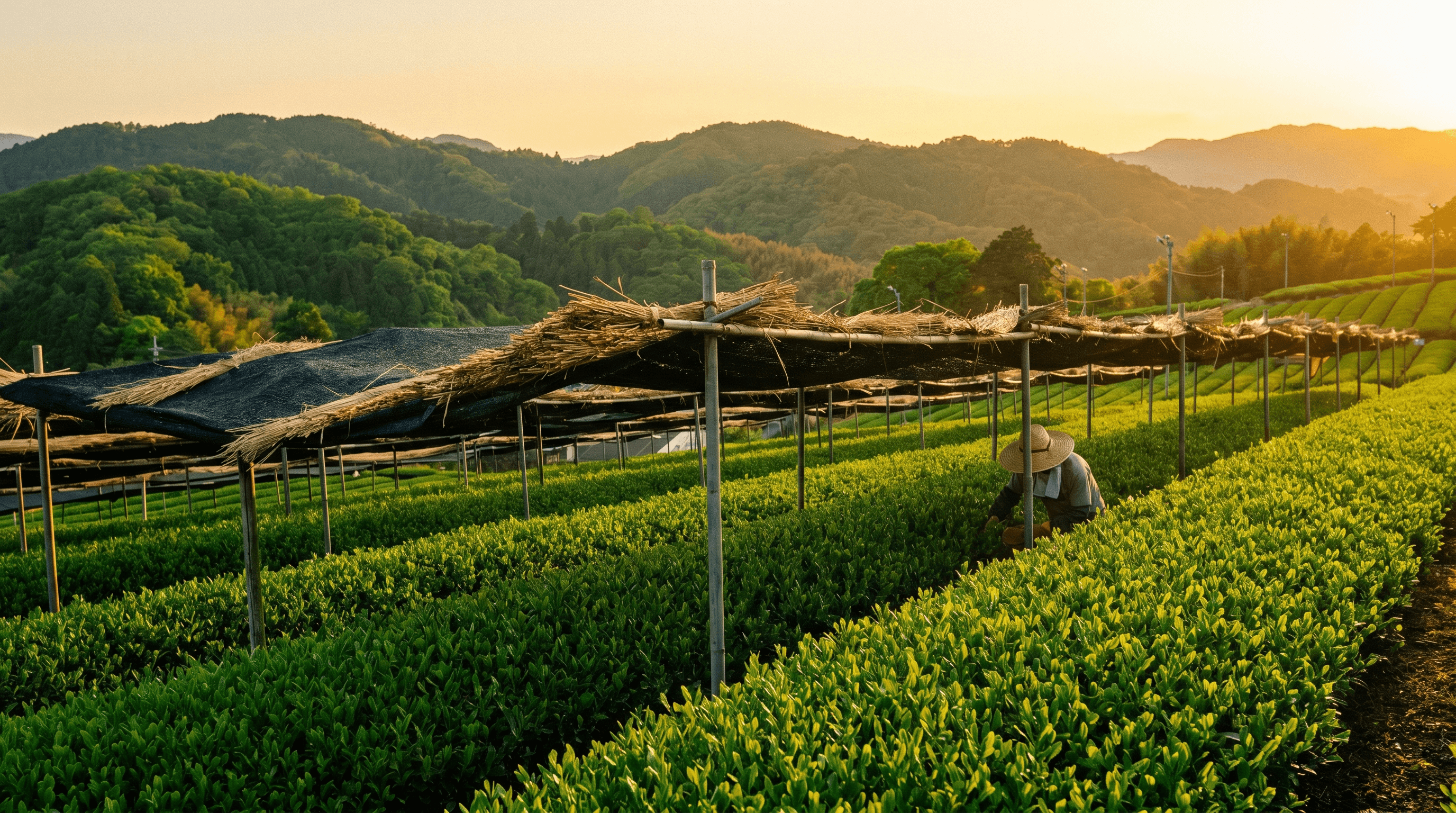
The Nishio region in Aichi Prefecture, which produces the largest volume of matcha in Japan, faces similar pressures. Tea cultivation is labor-intensive, particularly the shade-growing and hand-harvesting required for premium grades. Without enough workers, farms can't maintain — let alone expand — production.
3. Climate Change Is Disrupting Harvests
Japan's tea-growing regions have experienced increasingly erratic weather patterns. Unseasonable frosts in spring can devastate the critical first harvest (ichiban-cha), which produces the highest-quality matcha. Excessive summer heat and irregular rainfall affect leaf development and flavor profiles. Typhoon seasons have also intensified, posing risks to shade structures and crops.
The 2025 spring harvest in parts of Shizuoka and Kyoto was notably below average due to late frost events, compounding an already tight supply situation heading into 2026.
4. Limited Arable Land
Japan is a mountainous country. Only about 12% of its land is arable, and tea competes with other crops for that limited space. Converting existing tea fields to matcha production isn't simple either — tencha requires specific shade-growing infrastructure and different processing equipment than sencha or other green teas. Even if a farmer wanted to switch, the capital investment is substantial and the plants need years to mature.
How the Shortage Is Affecting Matcha Prices
The price impact is measurable and significant. Wholesale prices for authentic Japanese matcha have increased 20–40% since 2024, depending on the grade. Ceremonial-grade matcha from top-tier regions like Uji has seen even steeper increases, with some lots up 50% or more at auction.
For consumers, this translates to higher retail prices across the board. A 30-gram tin of genuine ceremonial matcha that cost $28 in 2023 might now retail for $35–$45. Café prices have followed — a matcha latte that was $5.50 two years ago is now $7 or more in many markets.
These aren't arbitrary markups. They reflect the real cost of producing an agricultural product with limited supply and growing demand. If a brand's matcha prices haven't gone up at all, that's actually worth questioning — it may mean they've changed what's in the tin.
How Some Brands Are Cutting Corners
Here's where the shortage gets problematic for consumers. When supply tightens and costs rise, some brands look for ways to maintain margins without raising prices. The most common shortcuts:
Blending with Chinese Powder
China produces large quantities of green tea powder, some of which is marketed as matcha. While China has a long history of tea cultivation, Chinese "matcha" is typically made from different cultivars, grown without traditional shade techniques, and processed differently. It's significantly cheaper — sometimes one-tenth the cost of Japanese matcha.
Some brands have begun blending Japanese matcha with Chinese green tea powder without disclosing it. The result is a product that looks similar but tastes noticeably different: more bitter, less umami, often with a yellowish-green hue rather than the vibrant emerald of pure Japanese matcha.
Using Second-Harvest Leaves
First-harvest (ichiban-cha) leaves are the gold standard for matcha — they're the most tender, highest in L-theanine, and produce the smoothest flavor. Second-harvest (nibancha) and later pickings produce harsher, more astringent tea with less nutritional density. As first-harvest supply gets tighter, some brands have quietly shifted to using later-harvest material while maintaining premium pricing and labeling.
Dropping from Ceremonial to Culinary — Without Updating Labels
Matcha grading isn't regulated by any international standard. There's no legal definition of "ceremonial grade." This means a brand can relabel what would have previously been sold as culinary-grade matcha as "ceremonial" without any regulatory consequence. During a shortage, this kind of grade inflation becomes more common.
How to Tell If Your Matcha Is Still High Quality
Despite the supply challenges, excellent matcha is still available — you just need to know what to look for. Here are the markers of quality that haven't changed:
- Color: Genuine ceremonial matcha is a vivid, bright green — almost electric. If it looks olive, yellowish, or dull, it's likely lower grade or not pure Japanese matcha.
- Texture: High-quality matcha feels silky and ultra-fine between your fingers. Gritty or coarse texture indicates poor stone-grinding or non-tencha material.
- Aroma: Fresh matcha smells vegetal and slightly sweet, with a clean, grassy note. Stale or low-grade matcha smells flat or hay-like.
- Taste: The hallmark of great matcha is umami — a savory richness with natural sweetness and minimal bitterness. If it's overwhelmingly bitter or astringent, the quality isn't there.
- Origin transparency: Trustworthy brands specify the region (Uji, Nishio, Kagoshima), the harvest season, and ideally the farm or cooperative. Vague labeling like "Product of Japan" with no further detail is a yellow flag.
- Price: In the current market, authentic ceremonial-grade Japanese matcha realistically costs $30–$50 per 30g. If something is priced dramatically below that range, be skeptical.
What This Means for Matcha Consumers in 2026
The shortage isn't a reason to panic, but it is a reason to be more intentional about what you buy. A few practical takeaways:
Expect to pay more. Matcha prices have gone up because production costs have gone up. This is the reality of an agricultural product with constrained supply. Brands that absorb 100% of cost increases without raising prices are making it up somewhere — usually in quality.
Buy from brands that are transparent about sourcing. This matters more now than ever. You want a brand that can tell you exactly where their matcha comes from, what harvest it's from, and how it's processed. If a brand's website doesn't address sourcing with any specificity, that's a signal.
Stock up when you find what you like. Supply fluctuations mean your preferred matcha may not always be available. If you find a product you trust, consider buying a few tins at a time. Stored properly (sealed, refrigerated, away from light), matcha keeps well for several months.
Be wary of new "matcha" products at suspiciously low prices. The shortage has created an opening for low-quality products to flood the market. If a new brand is offering "premium ceremonial matcha" at $12 for 100 grams, it's almost certainly not what it claims to be.
How AURI Sources Matcha During the Shortage
We'll be straightforward: the shortage affects us too. Our costs have increased, and maintaining our quality standard requires more effort than it did two years ago. Here's how we're navigating it.
AURI sources directly from tea farms in Uji and Kagoshima — two of Japan's premier matcha regions. We don't buy through brokers or commodity traders. Our direct relationships with farming cooperatives mean we secure allocation before matcha hits the open wholesale market, where prices spike the hardest.
We use exclusively first-harvest tencha for our Ceremonial Matcha, and high-quality first and early second-harvest for our Barista Matcha. We haven't changed those standards, and we won't. If a harvest doesn't meet our specifications, we pass on it rather than compromise.
We test every lot for color, particle size, amino acid content, and taste profile before it ships. We also run third-party heavy metal and pesticide testing on each batch. These aren't claims on a label — the results are available on our website.
Has our pricing adjusted? Yes. We've raised prices modestly to reflect real cost increases rather than absorb them in ways that would eventually force us to cut quality. We believe that's the honest approach — and we'd rather lose a sale on price than lose your trust on quality.
The Bigger Picture: Where Matcha Supply Goes from Here
The matcha shortage isn't going to resolve overnight. New tea plants take three to five years to reach harvest maturity. Japan's agricultural workforce challenges are structural, not cyclical. Climate volatility is an ongoing variable.
There are some positive developments. Japanese agricultural technology companies are investing in more efficient shade-growing systems. Several prefectures are offering subsidies to encourage younger farmers to enter tea cultivation. And there's growing research into cultivars that are more resilient to climate stress while maintaining the flavor profiles that define premium matcha.
But the demand side shows no signs of slowing. Matcha consumption in the U.S. alone grew over 20% year-over-year in 2025. Europe, Southeast Asia, and the Middle East are all expanding markets. The structural imbalance between supply and demand will likely persist through at least 2028.
For consumers who care about quality, the takeaway is clear: know your source, understand what you're paying for, and don't chase the lowest price in a market where the real product costs more to produce than ever before.
The Bottom Line
The 2026 matcha shortage is real, driven by a collision between flat Japanese production and exponentially growing global demand. Compounding factors — an aging farming workforce, climate disruptions, limited arable land — make a quick resolution unlikely.
For consumers, this means higher prices, more low-quality products entering the market, and a greater need to buy from brands that are transparent about where their matcha comes from and how it's made. The shortage doesn't mean good matcha is gone — it means you need to be more discerning about finding it.
AURI's commitment hasn't changed: direct-sourced, first-harvest Japanese matcha, tested and verified, at a fair price that reflects reality. Browse our Ceremonial Matcha and Barista Matcha to see — and taste — what that standard looks like.
Frequently Asked Questions
Is there really a matcha shortage in 2026?
Yes. Global demand for matcha — driven largely by Western markets — has outpaced Japanese production capacity. Japan produces roughly 3,000–4,000 metric tons of matcha-grade tencha annually, but worldwide demand now exceeds that by a significant margin, creating supply constraints across all quality tiers.
Why is matcha so expensive right now?
Several compounding factors: limited Japanese farmland dedicated to tencha, a shrinking and aging workforce in key growing regions like Uji and Nishio, climate disruptions affecting harvest yields, and surging global demand. Wholesale prices for authentic Japanese matcha have risen 20–40% since 2024.
How can I tell if a brand is cutting corners on matcha quality?
Watch for these red flags: unusually low prices (under $15 for 30g), dull yellow-green or olive color, gritty texture, bitter taste without umami, vague origin labeling (just 'Japan' with no region specified), or ingredient lists that mention 'green tea powder' rather than matcha. Some brands are also blending Japanese matcha with cheaper Chinese powder without disclosure.
Will the matcha shortage end soon?
Not quickly. New tea plants take 3–5 years to reach matcha-grade harvest quality, and Japan's structural challenges — aging farmers, limited arable land, climate volatility — don't have overnight solutions. Industry analysts expect tight supply conditions to persist through at least 2028.
Related Articles
Ready to Try AURI Matcha?
Premium ceremonial-grade matcha from Uji, Kyoto.
Shop Now