
Ceremonial Grade Matcha: What It Actually Means
What Does "Ceremonial Grade" Actually Mean?
Ceremonial grade matcha is the highest quality tier of matcha powder, traditionally reserved for Japanese tea ceremony (chanoyu). It's made exclusively from first-harvest, shade-grown tencha leaves — the youngest, most tender leaves at the top of the plant — that are de-stemmed, de-veined, and stone-ground into an ultra-fine powder.
The defining characteristic of ceremonial grade matcha is that it tastes good enough to drink straight. Whisked with hot water and nothing else — no milk, no sweetener — genuine ceremonial matcha delivers a smooth, naturally sweet, umami-rich flavor with minimal bitterness. If your matcha needs sugar or oat milk to be palatable, it's not ceremonial grade, regardless of what the label says.
Here's the critical thing most brands won't tell you: "ceremonial grade" is not an officially regulated or standardized term. There is no governing body in Japan or anywhere else that certifies matcha as ceremonial grade. Any company can slap the label on their product. This makes understanding what actually constitutes high-quality matcha more important than trusting marketing language.
The Grading System in Japan: It's Not What You Think
Many matcha brands present "ceremonial grade" and "culinary grade" as though they're part of an official Japanese classification system. They're not.
In Japan, the tea industry does not use a universal, government-mandated grading system for matcha. There is no Japanese Agricultural Standard (JAS) or industry-wide certification that defines what qualifies as "ceremonial grade." The terms used in the domestic Japanese market differ significantly from the simplified ceremonial/culinary framework that Western brands have adopted.
How Japanese Tea Producers Actually Grade Matcha
Within Japan, matcha quality is determined by several factors that tea producers and buyers evaluate:
- Harvest timing: First harvest (ichiban-cha, typically late April to May) is the most prized. Second harvest (niban-cha) and later pickings produce progressively lower quality.
- Shade duration: Longer shading periods (20-30+ days) produce higher L-theanine content and richer umami flavor.
- Leaf position: The youngest leaves at the very top of the plant are the finest. Lower, older leaves are coarser.
- Cultivar: Specific tea plant varieties (like Samidori, Okumidori, and Gokou) are preferred for high-end matcha.
- Processing: Proper de-stemming, de-veining (creating tencha), and slow stone-grinding are essential.
- Sensory evaluation: Professional tea tasters assess color, aroma, umami, sweetness, and astringency.
Japanese producers typically assign their own internal quality tiers and pricing based on these criteria. The highest-quality matcha goes to tea ceremony practitioners and premium retailers — and it commands prices that would shock most Western consumers (sometimes $50-$100+ per 30g at the farm level).
The "ceremonial vs. culinary" framework was largely created by Western importers to simplify the buying decision for international consumers. It's a useful shorthand, but it's not an official standard — which is exactly why you need to know what to look for beyond the label.
How to Identify Real Ceremonial Grade Matcha
Since you can't rely on the label alone, here are the concrete indicators that separate genuine ceremonial-quality matcha from the pretenders.
Color: The First and Most Reliable Test
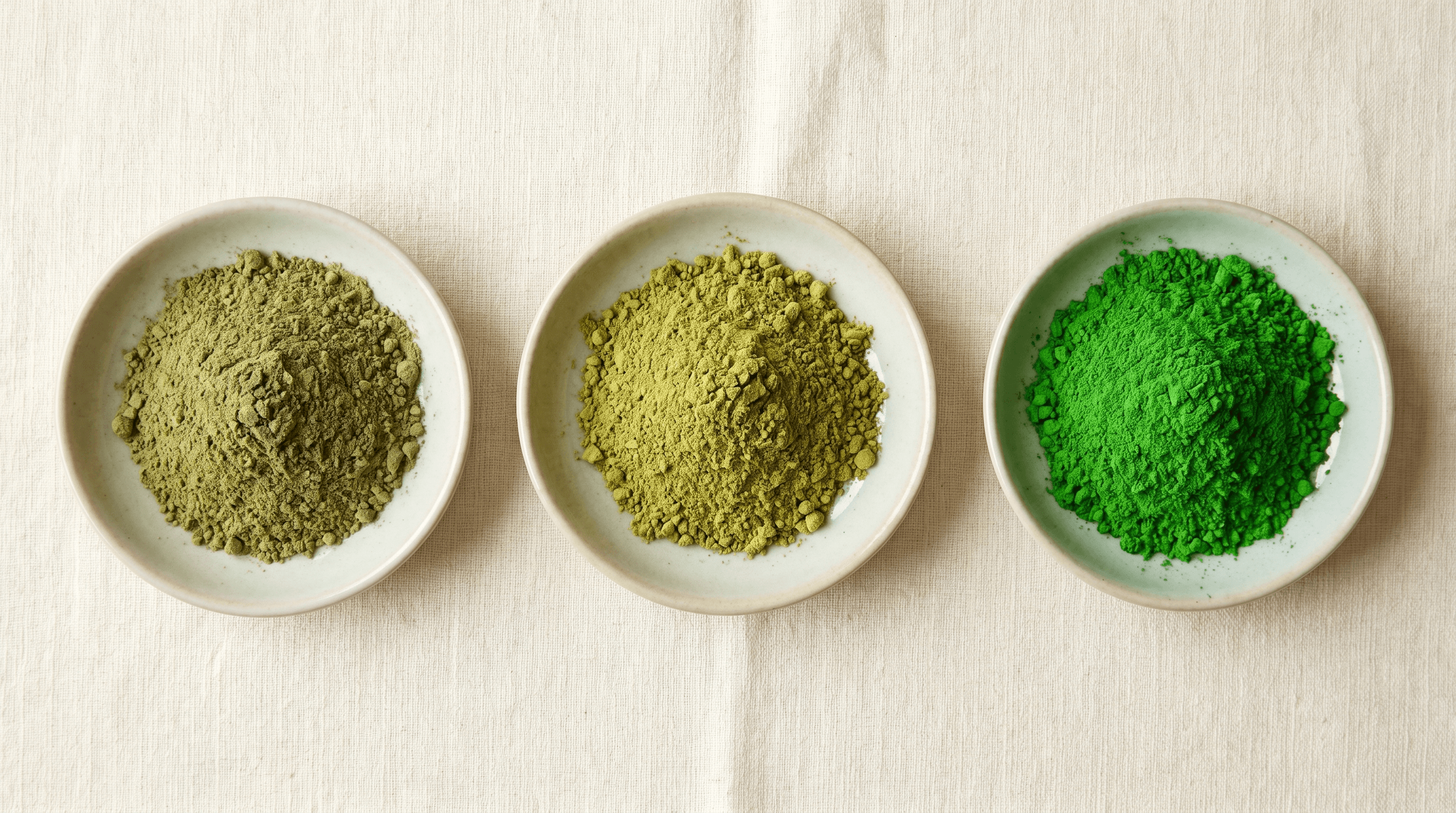
Authentic ceremonial matcha is a vivid, electric green — almost unnaturally bright. This color comes from high chlorophyll content, which is a direct result of proper shade-growing. The longer the tea plants are shaded before harvest, the more chlorophyll the leaves produce.
- Genuine ceremonial: Vibrant, vivid green with no yellow or brown tones
- Mid-range: Bright green but less intense
- Low quality: Olive green, yellow-green, khaki, or brownish — indicates insufficient shading, later harvest, or old stock
Color is your single best quick indicator. If the powder doesn't look strikingly green when you open the tin, it's not ceremonial quality.
Texture: Silk, Not Sand
True ceremonial matcha that has been stone-ground on traditional granite mills has an extraordinarily fine particle size — approximately 5-10 microns. For reference, that's finer than baby powder.
When you rub ceremonial matcha between your thumb and forefinger, it should feel like eyeshadow or talcum powder — completely smooth with zero grittiness. If it feels sandy or coarse, it was either ground using industrial methods (ball mills, jet mills) rather than traditional stone mills, or it contains stem and vein material that should have been removed during the tencha processing stage.
Taste: Umami First, Bitterness Last
The flavor profile of real ceremonial matcha is dominated by umami — that savory, almost brothy richness that signals high L-theanine content. Behind the umami, you should detect:
- Natural sweetness: A round, gentle sweetness — not sugary, but unmistakable
- Vegetal notes: Fresh, green, alive — like spring grass or steamed spinach, but pleasant
- Minimal bitterness: Some mild astringency is natural, but it should be a background note, not the dominant flavor
- Clean finish: The taste should fade cleanly rather than leaving a harsh aftertaste
If bitterness is the first thing you taste, it's not ceremonial grade — or it was prepared with water that was too hot.
Origin: Japan Is Non-Negotiable
Authentic ceremonial matcha comes from Japan. The premier growing regions are:
- Uji, Kyoto: The most storied matcha region with over 800 years of history. Uji matcha benefits from specific terroir — misty river valleys, mineral-rich soil, and ideal temperature fluctuations. AURI Ceremonial Matcha is sourced from Uji.
- Nishio, Aichi: Japan's highest-volume matcha region, producing excellent quality across all tiers.
- Kagoshima: Southern region with volcanic soil that creates a slightly different, often sweeter flavor profile.
"Matcha" produced in China is almost universally regular green tea ground into powder — it is not made from tencha (shade-grown, de-stemmed leaves) and is not stone-ground. It lacks the production process that defines matcha. If a product doesn't clearly state Japanese origin, assume it isn't.
Ceremonial vs. Culinary Matcha: Complete Comparison
Understanding the differences between ceremonial and culinary matcha helps you choose the right product for how you plan to use it.
| Factor | Ceremonial Grade | Culinary Grade |
|---|---|---|
| Intended use | Whisked with water, drunk straight | Lattes, baking, smoothies, cooking |
| Harvest | First harvest (ichiban-cha), spring | Second or later harvests |
| Leaf selection | Youngest leaves, top of plant only | Mix of leaf positions, sometimes older leaves |
| Color | Vibrant, electric green | Olive to yellow-green |
| Taste | Smooth umami, naturally sweet, minimal bitterness | Robust, astringent, more bitter |
| Texture | Ultra-fine, silky (5-10 microns) | Slightly coarser |
| L-theanine | High (longer shade, younger leaves) | Moderate |
| Caffeine | ~65-70mg per 2g serving | ~55-65mg per 2g serving |
| Price (30g) | $25-$50+ | $10-$25 |
| Best for | Traditional preparation, pure matcha experience | Matcha lattes, recipes, blended drinks |
Neither grade is inherently "better" — they serve different purposes. Whisking ceremonial matcha into a latte wastes its delicate flavor (the milk masks the nuance you're paying for). Using culinary matcha for a traditional bowl means drinking something unpleasantly bitter. Match the grade to the application.
That said, if you're exploring matcha for the first time and want to understand what the fuss is about, start with ceremonial grade whisked with water. It's the purest expression of what matcha can be. For a deeper breakdown, see our ceremonial vs culinary matcha guide.
How Ceremonial Grade Matcha Is Made
The production process for ceremonial matcha is what makes it expensive — and what makes it worth the price. Every step is designed to maximize flavor, color, and nutritional density.
Step 1: Shade Growing (20-30 Days)
Three to four weeks before harvest, tea plants destined for ceremonial matcha are covered with shade structures. Traditionally, this was done with straw (called "tana" shading); today, many farms use layered black vinyl sheets that block about 90% of direct sunlight.
This forced shade deprivation triggers a survival response in the plant: it dramatically increases chlorophyll production (turning the leaves a deeper green) and boosts L-theanine, the amino acid responsible for matcha's signature umami flavor and calm-focus effect. Without adequate shading, you cannot produce ceremonial-quality matcha — the chemistry simply isn't there.
Step 2: First Harvest (Ichiban-cha)
Ceremonial matcha is made exclusively from the first spring harvest, typically in late April to May. These first-flush leaves have spent all winter accumulating nutrients, making them the most flavorful and nutrient-dense of the year. Only the youngest, most tender leaves at the very top of the plant are picked — for the highest grades, this is done by hand.
Later harvests (second flush in June-July, third flush in August) produce leaves with progressively less L-theanine and more catechins, shifting the flavor balance from smooth umami toward astringent bitterness. This is why harvest timing is one of the single biggest quality determinants.
Step 3: Steaming and Drying
Within hours of picking, leaves are briefly steamed to halt oxidation — preventing them from turning into black tea. They're then air-dried. This raw product is called aracha (crude tea).
Step 4: De-Stemming and De-Veining (Creating Tencha)
This is the step that separates real matcha from generic green tea powder. The dried leaves are carefully stripped of all stems and veins, leaving only the pure leaf flesh. This refined product is called tencha — and it's the only proper starting material for matcha.
Green tea powder (sold cheaply on Amazon as "matcha") is often just ground sencha — whole leaves with stems and veins included. Tencha production is what gives matcha its smooth texture and clean flavor. If the process skips this step, it's not matcha.
Step 5: Stone Grinding
Tencha leaves are ground into powder using traditional granite stone mills called ishi-usu. These mills turn extremely slowly — producing only about 40 grams per hour per mill. This glacial pace is deliberate: faster grinding generates heat through friction, which degrades chlorophyll, denatures amino acids, and oxidizes the delicate compounds that give ceremonial matcha its color, flavor, and nutritional value.
For context, grinding enough matcha to fill a single 30g tin takes nearly an hour on one mill. This is the primary reason ceremonial matcha costs what it does — the bottleneck is literally the speed of stone.
How to Prepare Ceremonial Matcha: The Traditional Method
Ceremonial matcha deserves ceremonial preparation. The traditional method is simple but precise:
What You Need
- Matcha: 2g (about 1 teaspoon) of ceremonial grade matcha
- Water: 60-70ml (about 2oz) heated to 175°F (80°C) — never boiling
- Bowl (chawan): A wide bowl gives your whisk room to move
- Bamboo whisk (chasen): The traditional tool, designed specifically for matcha
- Fine-mesh sieve: For sifting out clumps
Our Matcha Starter Kit includes all of these tools plus 30g of AURI Ceremonial Matcha — everything you need in one box.
Preparation Steps (Usucha — Thin Tea)
- Sift 2g of matcha through a fine-mesh sieve into your bowl. This breaks up clumps and ensures a smooth result. Takes 10 seconds — don't skip it.
- Add water. Pour 60-70ml of 175°F water over the sifted powder. If you don't have a thermometer, bring water to a boil and let it cool for 3-4 minutes.
- Whisk vigorously with your chasen in a rapid W or M motion (not circular) for 15-20 seconds. You should see a fine, uniform layer of foam form on the surface.
- Drink immediately. Matcha begins settling within a minute. It's best consumed right away while the flavor is brightest and the texture is smooth.
The water temperature is critical. Boiling water (212°F) scorches matcha, destroying its delicate flavors and releasing excessive bitterness. The 175°F sweet spot extracts the umami and sweetness while keeping bitterness in check.
Why Ceremonial Matcha Costs More
Ceremonial matcha commands a premium for concrete reasons — none of which are marketing fluff:
- Shade structures: Building, maintaining, and deploying shade covers for weeks before harvest is labor-intensive and costly.
- First harvest only: Using only first-flush leaves means one shot per year. Farmers can't make up volume with later harvests.
- Hand-picking: The highest grades are picked by hand, selecting only the youngest top leaves.
- Tencha processing: Removing every stem and vein is meticulous and generates significant waste — a large volume of leaf material yields a relatively small amount of pure tencha.
- Stone grinding at 40g/hour: This is the biggest bottleneck. Each granite mill produces about one tin per hour. A farm might have dozens of mills running, but it's still fundamentally slow.
- Limited supply: The combination of first-harvest timing, hand selection, and slow grinding means genuine ceremonial matcha is produced in limited quantities each year.
When you pay $25-$50 for a 30g tin of real ceremonial matcha, you're paying roughly $1.50-$3.00 per serving. That's less than any cafe matcha drink and a fraction of the cost of most daily coffee habits — for a dramatically superior product.
What to Look for When Buying Ceremonial Matcha
Since "ceremonial grade" isn't regulated, you need to evaluate the product on its actual merits. Here's your buying checklist:
Must-Haves
- Japanese origin — clearly stated. Ideally Uji (Kyoto), Nishio (Aichi), or Kagoshima. If the origin isn't specified, that's a red flag.
- Single ingredient: The label should list one thing — matcha (or tencha powder, or green tea powder from tencha). No sugar, no maltodextrin, no "natural flavors."
- Opaque, airtight packaging: Matcha degrades rapidly in light and air. Tins or foil-lined resealable pouches are standard. Clear bags or jars mean the matcha has been losing quality on the shelf.
- Vibrant green color: If you can see the product (or if reviews mention color), it should be notably bright green.
- Price above $25 per 30g: Below this threshold, the economics of genuine ceremonial production don't work. Something has been cut.
Nice-to-Haves
- Harvest information: Year and season (first flush / ichiban-cha) shows the producer tracks freshness.
- Cultivar specified: Named cultivars (Samidori, Okumidori, Gokou, Asahi) indicate a producer who cares about craft.
- Farm or region detail: Single-origin matcha from a specific farm is the tea equivalent of single-origin coffee.
Red Flags: Fake and Low-Quality "Ceremonial" Matcha
The matcha market is full of products that claim ceremonial grade but don't deliver. Watch for these warning signs:
"Ceremonial Grade" Under $15-$20 for 30g
This is the single biggest red flag. The cost of shade-growing, first-harvest picking, tencha processing, and stone-grinding simply cannot produce ceremonial matcha at bargain prices. If it's cheap, it's either not first-harvest, not stone-ground, not from tencha, not from Japan — or some combination of all four.
No Origin Specified
Legitimate Japanese matcha producers are proud of their origin. If a brand doesn't clearly state the country and ideally the region, the matcha is likely from China or a blend of unknown sources. Chinese "matcha" is almost always ground sencha or green tea powder, not true tencha-based matcha.
Dull, Yellow-Green, or Brown-Tinted Color
If the matcha looks olive, khaki, or brownish, it's either from later harvests, insufficiently shaded, old stock, or improperly stored. Genuine ceremonial matcha is vivid green — there's no ambiguity.
Gritty Texture
Run a small amount between your fingers. Real stone-ground matcha from tencha is silky smooth. Gritty or sandy texture means it was either ground using industrial methods or contains stem/vein material from incomplete processing.
Additives on the Ingredient List
Sugar, maltodextrin, artificial color, "natural flavors," milk powder — any of these on a product labeled "ceremonial matcha" means it's not pure matcha. Some brands sell "matcha blends" or "matcha mixes" that contain very little actual matcha.
Transparent or Poorly Sealed Packaging
Matcha stored in clear bags, jars, or containers with loose lids has been degrading from light and oxygen exposure since the day it was packed. Quality matcha producers use opaque, airtight tins or foil-sealed pouches for a reason.
AURI Ceremonial Matcha: What Makes Ours Different
We built AURI around a simple premise: make it easy to get genuine, high-quality matcha without the guesswork. Here's exactly what's in our Ceremonial Matcha:
- Origin: Single-origin, first-harvest matcha from Uji, Kyoto
- Processing: Traditional tencha production (fully de-stemmed and de-veined), stone-ground on granite ishi-usu mills
- Color: Vivid, bright green — check for yourself
- Flavor: Smooth umami, natural sweetness, clean finish, minimal bitterness
- Ingredients: 100% matcha. That's it.
- Packaging: Opaque, airtight tin to preserve freshness
If you're new to matcha and want the complete setup, our Matcha Starter Kit pairs the ceremonial matcha with a bamboo chasen, chashaku scoop, and ceramic bowl — everything you need for traditional preparation, ready to go out of the box.
The Bottom Line
"Ceremonial grade matcha" should mean the best matcha available — first-harvest, shade-grown, stone-ground from pure tencha, with a flavor profile refined enough to drink straight. But because the term isn't regulated, the market is full of products that use the label without meeting the standard.
Now you know what to look for: vivid green color, silky texture, umami-forward taste, Japanese origin, clean ingredient list, and a price point that reflects the real cost of production. Armed with those criteria, you can cut through the marketing and find matcha that actually deserves the name.
Start with AURI Ceremonial Matcha and taste the difference for yourself.
Frequently Asked Questions
What does ceremonial grade matcha mean?
Ceremonial grade matcha refers to the highest quality matcha, traditionally made from first-harvest, shade-grown tencha leaves that are stone-ground into an ultra-fine powder. It's intended for drinking straight with water — no milk or sweetener needed. However, 'ceremonial grade' is not a regulated or officially standardized term, so quality varies widely between brands.
Is ceremonial grade matcha worth the price?
Yes, if it's genuine. Real ceremonial matcha costs $25-50 per 30g because of the labor-intensive production: 3-4 weeks of shade-growing, hand-picking first-harvest leaves, de-stemming and de-veining, and slow stone-grinding at 40g per hour. The taste difference compared to lower grades is dramatic — smooth umami sweetness versus harsh bitterness.
What is the difference between ceremonial and culinary matcha?
Ceremonial matcha is made from first-harvest, youngest leaves and is meant to be whisked with water alone. It has a vibrant green color, smooth umami flavor, and ultra-fine texture. Culinary matcha uses later-harvest leaves, has a stronger and more astringent flavor designed to hold up in lattes, baking, and cooking, and costs less.
How can you tell if ceremonial matcha is real?
Look for vibrant electric-green color, ultra-fine silky texture, smooth umami taste with minimal bitterness, Japanese origin (ideally Uji, Nishio, or Kagoshima), and a price of at least $25 per 30g. Red flags include dull yellow-green color, gritty texture, no origin listed, added ingredients, and suspiciously low prices.
How do you prepare ceremonial grade matcha?
Sift 2g (about 1 tsp) into a bowl, add 60-70ml of 175°F water (not boiling), and whisk vigorously with a bamboo chasen in a W motion for 15-20 seconds until a fine foam forms. Drink immediately. Ceremonial matcha should be enjoyed straight — no milk or sweetener — to appreciate its full flavor profile.
Related Articles
Ready to Try AURI Matcha?
Premium ceremonial-grade matcha from Uji, Kyoto.
Shop Now